
Prime Minister Shahbaz Sharif Affirms Uncompromising Commitment to the Sanctity and Security of the Two Holy Mosques
Prime Minister Shahbaz Sharif Affirms is covered in the report below.
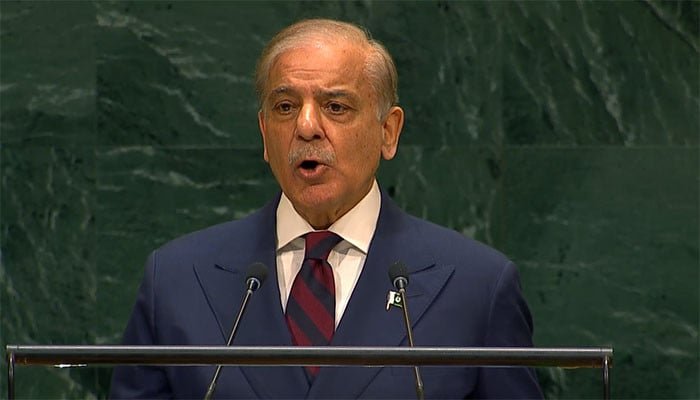
In a fervent address at the 81st UN General Assembly, Prime Minister Shahbaz Sharif emphasized Pakistan’s unwavering commitment to the sanctity and security of the Two Holy Mosques, stating that the
In a fervent address at the 81st UN General Assembly, Prime Minister Shahbaz Sharif emphasized Pakistan’s unwavering commitment to the sanctity and security of the Two Holy Mosques, stating that there will be no compromise in this regard. He strongly condemned recent attacks against Saudi Arabia and clarified that the alliance between Pakistan, Turkey, and Saudi Arabia is not directed against any nation.
Prime Minister Shahbaz Sharif Affirms: Commitment to Peace and Diplomacy
Beginning his address with a Quranic verse, Prime Minister Sharif offered congratulations to Khalil Rahman on his election as President of the General Assembly, assuring him of Pakistan's full support. He acknowledged that this marks his fourth address to the UN General Assembly, reaffirming Pakistan's commitment to the principles outlined in the UN Charter. "I represent the peace-loving people of Pakistan," he asserted, recalling the efforts made to bring the United States and Iran to the negotiating table.
Highlighting the strategic significance of the Strait of Hormuz, he warned that vital maritime routes were under stress due to ongoing conflicts. He praised the diplomatic efforts of Field Marshal Asim Munir, calling for continued demands for diplomacy and for crucial passageways like Hormuz and Bab-el-Mandeb to remain open, avoiding their transformation into conflict zones. Furthermore, he condemned Israeli aggression towards Lebanon and Syria.
Addressing Regional Conflicts
Prime Minister Sharif pointed out that India had launched an aggressive attack on Pakistan under false pretenses and reiterated Pakistan's right to self-defense as outlined in the UN Charter. Under Field Marshal Asim Munir's leadership, he stated, Pakistan effectively countered Indian aggression and delivered a lesson that India would never forget.
He attributed the saving of millions of lives in South Asia to the visionary leadership of President Trump, emphasizing the necessity of preventing the region from recurring to the brink of all-out war and underscoring the need for a resolution to the Kashmir issue.
The Kashmir Question
The Prime Minister called for a referendum in Kashmir under UN auspices, advocating for the rights of the Kashmiri people who, he noted, have faced collective punishment and demographic changes in the region. He assured the Kashmiri populace that Pakistan would continue its diplomatic and moral support until they receive their due rights, declaring Kashmir as Pakistan's lifeline.
He stressed that a just resolution of the Kashmir issue was essential for peace in the region, stating, "For eight decades, the people of occupied Kashmir have awaited action from the United Nations. The UN must fulfill its promises regarding the right to self-determination for Kashmiris."
Water Issues and Palestinian Rights
Discussing the Indus Waters Treaty, he remarked, "The waters of the Indus Basin belong to the entire region," criticizing India's unilateral actions to terminate the treaty, which he argued hold no legal value as recognized by both the UN and international courts.
On the Palestinian issue, Prime Minister Sharif lamented that generations of Palestinians have fought for freedom, insisting that children born in Gaza deserve the same rights as those born elsewhere. He condemned the forced eviction of Palestinians as indicative of Israel's genocidal agenda, advocating for the establishment of a Palestinian state based on the pre-1967 borders and denouncing ongoing Israeli aggression against Lebanon and Syria.
Countering Terrorism
Prime Minister Sharif highlighted the existential threat posed by terrorism to global peace and security, asserting that Pakistan has stood as a front-line state against terrorism, having sacrificed over 100,000 lives and incurred an economic cost of approximately $150 billion in its fight against extremism. He credited the sacrifices of the armed forces and civilians for a safer world, asserting that the peace-loving global community cannot deny Pakistan's enduring sacrifices.
He also addressed the current threats posed by groups like TTP and BLA, urging Afghan authorities to take immediate action to prevent the use of Afghan soil against Pakistan.
