
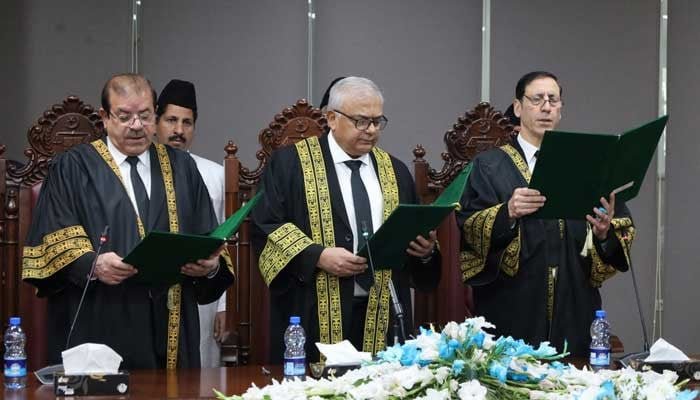
FCC Commences Operations Following Swearing-in of New Judges
FCC commenced operations is covered in the report below.
ISLAMABAD: In a significant development for Pakistan's constitutional and judicial landscape, the Federal Constitutional Court (FCC) commenced its operations on November 17, 2025, with the sweari
ISLAMABAD: In a significant development for Pakistan's constitutional and judicial landscape, the Federal Constitutional Court (FCC) commenced its operations on November 17, 2025, with the swearing-in of two additional judges. Chief Justice Aminuddin Khan administered the oaths to Justice Rozi Khan Barrech and Justice Arshad Hussain Shah in the Islamabad High Court's (IHC) conference room, raising the total number of judges on the court to seven.
FCC commenced operations: Context of the FCC's Establishment
The establishment of the FCC is a direct result of the recently enacted 27th Constitutional Amendment, which aims to enhance judicial representation and efficiency. Saturday's ceremony marked the swearing-in of Justice Muhammad Kareem Khan Agha, following the earlier appointments of Justice Syed Hasan Azhar Rizvi, Justice Aamer Farooq, and Justice Ali Baqar Najafi. This newly formed court promises equal provincial representation and delineates the roles of the president and prime minister in judicial appointments.
Key Powers and Amendments
One of the pivotal changes introduced by the 27th Amendment is the transfer of powers traditionally held by the Supreme Court to the FCC. The FCC is now empowered to hear constitutional cases and take suo motu notice—an important judicial function for addressing issues without requiring a formal petition. Chief Justice Yahya Afridi, who has served since October 30, 2024, will remain in his position until his three-year term concludes. Subsequently, the senior-most judge among both the Supreme Court and FCC justices will assume leadership.
The recent judicial reforms also facilitated the dissolution of the Constitutional Benches and authorized a three-member committee—headed by the chief justice—to form case-hearing benches. This committee will consist of the chief justice, the most senior judge, and a third judge selected by the chief justice. In instances where a member is unavailable, the chief justice retains the right to appoint another judge. Decisions regarding bench formation will be reached by majority vote.
Additionally, the retirement age for judges on the Constitutional Court has been set at 68 years, three years older than the retirement age for Supreme Court judges, who currently retire at 65.
Formation of FCC Benches
In light of these developments, Chief Justice Aminuddin Khan has constituted three operational benches. Bench 1 includes Chief Justice Khan, Justice Ali Baqar Najafi, and Justice Arshad Hussain Shah. Bench 2 comprises Justice Syed Hasan Azhar Rizvi and Justice Muhammad Kareem Khan Agha, while Bench 3 includes Justice Aamer Farooq and Justice Rozi Khan Barrech. The proceedings of the FCC have officially begun in the Islamabad High Court's Court Room No. 2 under the leadership of Justice Aminuddin Khan.
Simultaneously, the transition of courtrooms is in progress, with IHC Chief Justice Sarfraz Dogar scheduled to adjudicate cases in Court No. 1, while FCC Chief Justice Aminuddin Khan will preside over cases in Court No. 2. Notably, Justice Mohsin Akhtar Kayani's court has been reassigned to Justice Miangul Hassan Aurangzeb's court. Justices Farooq and Rizvi will handle cases on the second floor, where courts of IHC Justices Muhammad Asif and Khadim Hussain Soomro are located. However, the schedule for Justices Asif and Soomro has been canceled for today.
